Kdo se je poročil s Stanisław Leszczyński?
Catherine Opalińska poročen Stanisław Leszczyński leta . Starostna razlika je bila 2 leti, 11 mesecev in 23 dni.
Stanisław Leszczyński: Časovnica zakonskega stanja
1 Pixel = 1 Month

Stanisław Leszczyński

Stanisław I Leszczyński (Stanisław Bogusław; 20 October 1677 – 23 February 1766), also Anglicized and Latinized as Stanislaus I, was twice King of Poland and Grand Duke of Lithuania, and at various times Prince of Deux-Ponts, Duke of Bar and Duke of Lorraine.
During the Great Northern War, multiple candidates had emerged after the death of John III Sobieski for the elective kingship of Poland (which also included the Grand Duchy of Lithuania as part of the Poland-Lithuanian Commonwealth). Backed by powerful neighbors in Russia and Austria, the Sejm elected Augustus the Strong, Elector of Saxony to succeed John III in 1697 as August II. Russia's primary antagonist in the Great Northern War, Sweden had supported Stanisław Leszczyński for the throne, and after defeating a combined army of Saxon and Polish-Lithuanian forces, deposed August II and installed Leszczyński as Stanisław I in 1704.
In 1709, Charles XII of Sweden, Stanisław's main supporter, suffered a defeat by the Russians at the Battle of Poltava, and was subsequently driven into exile in the Ottoman Empire. As a result, Augustus II returned to the throne, and while Charles served his exile in the Ottoman Empire, Stanisław accepted the rule of the tiny state of Palatine Zweibrücken, a small state of the Holy Roman Empire which was in personal union with Sweden and located near the region of Alsace. After Charles's death in 1719, he moved to nearby Wissembourg in Alsace. In 1725, his daughter Marie Leszczyńska married Louis XV of France.
The death of Augustus II sparked the War of the Polish Succession in 1733. As had happened on the death of John III Sobieski, foreign intrigue and influence plagued the Sejm election. Despite the presence of Russian troops in the country, the Sejm, with support of the French, elected Stanisław to succeed Augustus II, while the Russians encouraged a group of break-away nobles to hold their own election, selecting instead Frederick Augustus II of Saxony, son of Augustus II, to the kingship. War broke out almost immediately, evolving into a proxy war between the Bourbon and Habsburg dynasties and their supporters, with the Bourbon faction led by France and Spain, with their allies Sardinia and Sweden, while the Habsburg faction was led by Austria and their allies Russia, Prussia, and Saxony. After two years of fighting across the entire continent, a ceasefire was declared in 1735. Stanislaus officially abdicated in January 1736, and the Peace of Vienna was promulgated in 1738, whereby Augustus III was officially recognized as King of Poland, and Stanisław was compensated for losing the throne a second time with the duchies of Bar and Lorraine, both of which were nominally part of the Holy Roman Empire at the time.
While Duke of Lorraine, Stanisław lived out his remaining years at a country estate in Lunéville, and actively ruled Lorraine and Bar, sponsoring numerous public works projects. Nearby, Nancy, the historic capital of Lorraine, has a Place Stanislas (Stanisław Square) named in his honour, much of which was developed during his reign. He also took up political philosophy, engaging in discourse with other Enlightenment figures such as Jean Jacques Rousseau, and wrote philosophical treatises in his native Polish, making him a figure within the Polish Enlightenment. When he died in 1766, his titles passed to his son-in-law, Louis XV. His retaking of the Polish throne in 1733 formed the backdrop for Un giorno di regno, an opera by composer Giuseppe Verdi and librettist Felice Romani, which premiered in 1840.
Preberite več...
Catherine Opalińska
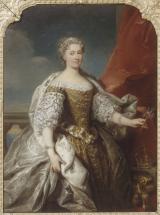
Countess Catherine Opalińska (Polish: Katarzyna Opalińska; 13 October 1680 – 19 March 1747), was by birth member of House of Opaliński, Queen consort and Grand Duchess consort of the Polish–Lithuanian Commonwealth twice and Duchess consort of Lorraine through her marriage with Stanisław I of Poland and Lithuania.
Born into the Polish aristocratic family of Opaliński, Catherine married Stanisłaus Leszczyński in 1698 and six years later he was elected as King of Poland and Grand Duke of Lithuania, due to the support of Charles XII of Sweden where she repaid this favour by favouring Swedish people at court.
In 1708 Catherine was sent to Stettin due to the increasingly unstable political environment and a year later her husband was deposed due to the loss of Swedish dominance in the Commonwealth; and she and her family were exiled to Sweden and were welcomed by the dowager queen, Hedwig and they became popular members of high society. In 1714 they moved to the Swedish ruled town of Zweibrücken where they were supported by the state. However, after the death of Charles in 1718 they moved to Wissembourg where the family were subjected to cramped conditions and because of this Catherine began feeling annoyance towards her husband but in 1725 their only surviving child, Maria, married the King of France, which was massive upgrade in status.
In 1733 Stanisłaus was restored to the Polish-Lithuanian throne during the War of Polish Succession, thanks to French support, but only three years later he abdicated. The peace treaty made Catherine Duchess of Lorraine but her husband had to give up rights to the Polish-Lithuanian throne. She never fully adjusted to life in Lorraine and always longed for Poland-Lithuania but suffered from ill health, which hindered her opportunities to attend court. Upon their arrival Stanisłaus immediately began taking up mistresses which most of the time, came from her household. Catherine died on 19 March 1747 and a grand funeral service was staged by her son-in-law at Notre Dame.
Preberite več...